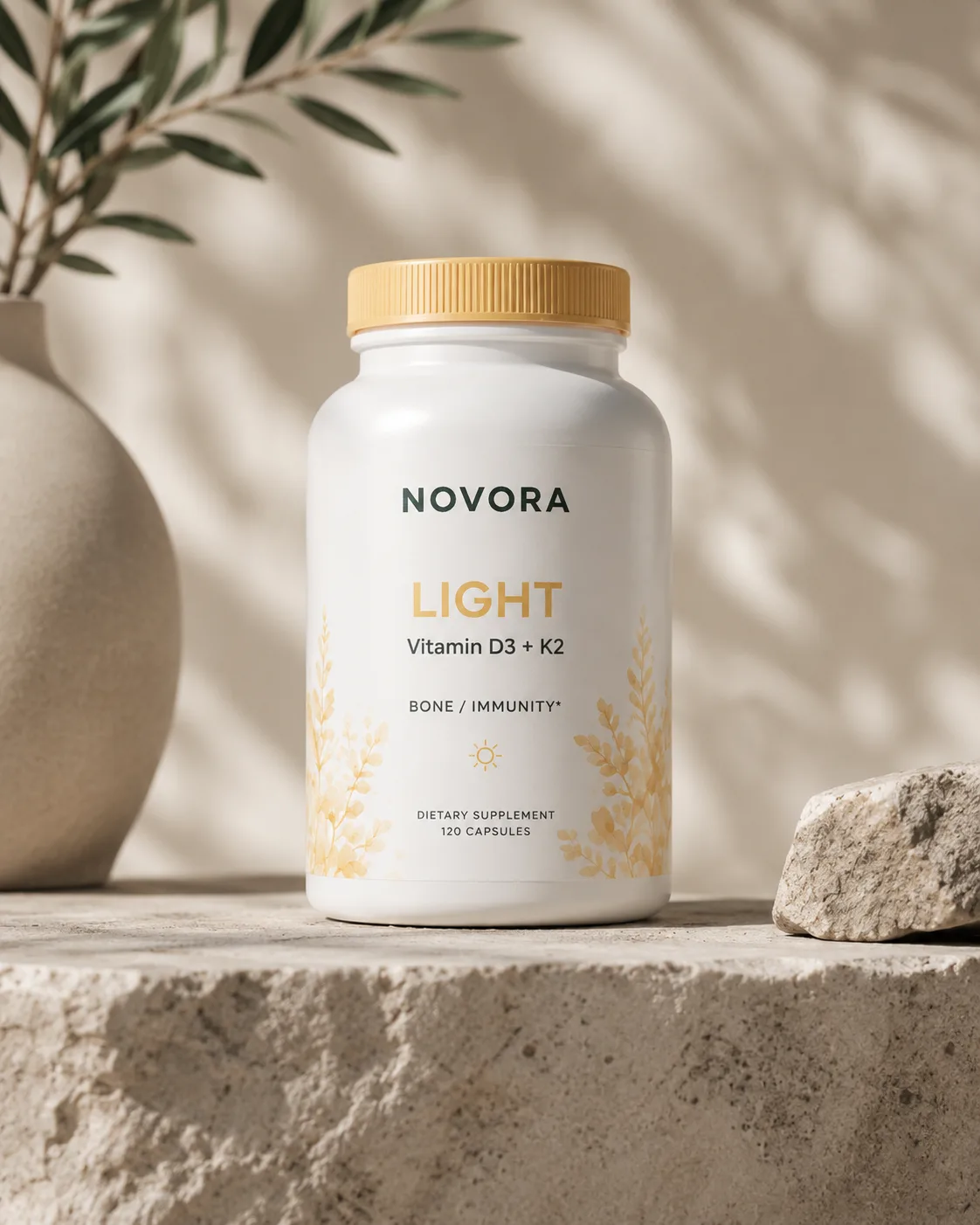
Vitamin D in the Nordic winter: what you need to know
From October to March, your skin simply can’t make enough — no matter how much time you spend outside.

Why winter up here is different
Vitamin D is made in your skin when UVB rays hit it — but at Nordic latitudes in winter, the sun sits too low in the sky for UVB to reach the ground at all, regardless of how clear the day is. It isn’t a matter of getting outside more; the raw material simply isn’t there from roughly October to March.
D3 vs D2
D3 (cholecalciferol) is the form your body makes naturally and the form most research is built around; D2 (ergocalciferol) is plant-derived and generally considered less effective at raising and maintaining blood levels. Most supplements worth taking are D3.
Why some formulas pair it with K2
Vitamin D helps your body absorb calcium; K2 helps direct that calcium to your bones rather than your arteries. They’re not the same nutrient doing the same job, which is why some products combine them — LIGHT is formulated around D3 specifically, at a dose (2,000 IU) sized for Nordic winters, so if K2 matters to you, it's worth adding as its own supplement rather than assuming it's included.
How much is enough
Requirements vary by body weight, baseline levels and skin tone, which is part of why a blood test is the only way to know your actual status. As a general daily maintenance dose through the darker months, most guidance for Nordic countries lands meaningfully higher than the minimums set for sunnier climates.
Signs you might be running low
Low vitamin D is easy to miss because the signs are vague — persistent tiredness, a low mood that lingers past the usual winter blues, or aching joints and muscles without an obvious cause. None of these confirm anything on their own; they're just common enough in deficient populations to be worth paying attention to, especially if they show up reliably every winter.
Vitamin D and mood — what's real, what's overstated
Vitamin D receptors exist in areas of the brain involved in mood regulation, and low levels are more common in people with seasonal low mood — but correlation isn't the same as proof of cause. The honest position is that vitamin D is a plausible piece of the winter-mood puzzle, not a proven treatment for it. Seasonal low mood that's significantly affecting daily life is worth discussing with a doctor, not something to self-treat with a supplement alone.
Testing your levels
A blood test (25-hydroxyvitamin D) is the only way to know your actual status rather than guess from symptoms. It's a standard, inexpensive test most doctors can order, and it's the most reliable way to confirm whether low levels are actually contributing to how you're feeling before assuming a supplement is the fix.
Food sources vs supplementation
Fatty fish, egg yolks and fortified foods contain vitamin D, but realistically getting a meaningful daily amount from Nordic winter diets alone is difficult — it would take a lot of oily fish, consistently, to match what a modest daily supplement provides. Food sources are a helpful supporting habit, not a substitute for supplementation through the darkest months.
What to expect
Vitamin D supports immune function and bone health over the long run — it’s not something you’ll feel working day to day. Consistency through the winter months matters more than any single dose.
Who's most at risk of running low
Risk isn't evenly spread: people who spend most daylight hours indoors, night-shift workers, older adults (whose skin produces vitamin D less efficiently from sunlight even in summer), people with darker skin tones (which naturally reduces UVB-driven synthesis), and anyone carrying more body fat (vitamin D is fat-soluble and gets sequestered in fat tissue) all tend to run lower. None of this is a diagnosis — it's just where a blood test is most worth prioritizing if you're deciding whether to check.
Vitamin D and immune function — what's actually established
Vitamin D receptors exist throughout the immune system, and observational research consistently links low levels with higher rates of respiratory infection. The more cautious, accurate framing is that adequate vitamin D status supports normal immune function — it's not shown to prevent illness outright, and claiming otherwise oversells what the evidence actually supports.
Does it work alongside omega-3s?
They support overlapping areas — cardiovascular and immune health — through different, unrelated mechanisms, so there's no interaction to worry about combining them. Many people already take an omega-3 supplement alongside vitamin D through the darker months, since both are fat-soluble and easy to fold into the same meal.
Year-round use vs. stopping in summer
Even with more daylight, most people at Nordic latitudes still don't get consistent enough sun exposure on bare skin to maintain summer-adequate levels — clothing, sunscreen, indoor work and simply not being outside at midday all cut into it. Some people scale down their dose in summer rather than stopping outright, but this is genuinely a personal, blood-test-informed decision rather than a fixed rule.
A note on obesity and absorption
Because vitamin D is stored in fat tissue, people with a higher body fat percentage often need a higher maintenance dose to reach the same blood level as someone leaner taking the same amount — one more reason a blood test, rather than a standard label dose, is the more reliable way to know what your body actually needs.
How Nordic guidance differs from lower-latitude countries
Public health bodies in Nordic countries generally recommend higher baseline vitamin D intake through autumn and winter than countries closer to the equator, precisely because the UVB shortfall is so much more severe and prolonged here. It's a useful reminder that generic international dosing advice — often written with a broader, sunnier range of latitudes in mind — doesn't always translate directly to a Scandinavian winter, and local guidance is the more relevant reference point.
Frequently asked questions
Can I get enough from food alone in winter?+
It's difficult. Oily fish and fortified foods contribute, but matching a Nordic winter's vitamin D needs from diet alone would require eating them in amounts most people don't realistically sustain.
Is more always better?+
No — vitamin D is fat-soluble, meaning your body stores it rather than excreting excess quickly, so more isn't automatically better. Stick to the suggested daily amount unless a doctor advises otherwise based on a blood test.
Can you take too much vitamin D?+
Yes, in principle, though it generally requires sustained very high doses well above standard supplement levels. It's rare from normal supplement use, but it's part of why blood testing matters if you're unsure of your levels.
Does sunscreen block vitamin D production?+
Sunscreen does reduce UVB penetration, but in Nordic winter the practical issue is that there's essentially no UVB reaching the ground at all — sunscreen isn't the limiting factor between October and March.
Should children take it too?+
Many Nordic health authorities already recommend vitamin D supplementation for children through the darker months — check current local guidance and your pediatrician's recommendation for age-appropriate dosing.
What's the best time of day to take it?+
Vitamin D is fat-soluble, so taking it with a meal that contains some fat — breakfast or lunch work well — supports better absorption than taking it on an empty stomach.
Do I still need a supplement if I already take a general multivitamin?+
Depends on the dose in the multivitamin — many contain vitamin D at a baseline level well below what's typically recommended for Nordic winters. Check the label's actual IU or mcg amount rather than assuming "it's covered" by default.
Does body weight affect how much I need?+
Yes — because it's fat-soluble and stored in fat tissue, people with more body fat generally need a higher dose to reach the same blood level as someone leaner. This is another reason a blood test is more reliable than guessing from a standard label dose.
Does LIGHT include K2?+
No — LIGHT is formulated around vitamin D3 (2,000 IU) specifically. If you want K2 alongside it, that's worth sourcing as its own supplement; both are fat-soluble, so they can be taken with the same meal.
This article is for general information and isn’t medical advice. Talk to a healthcare professional before starting any new supplement, especially if pregnant, nursing, under 18, or managing a medical condition.