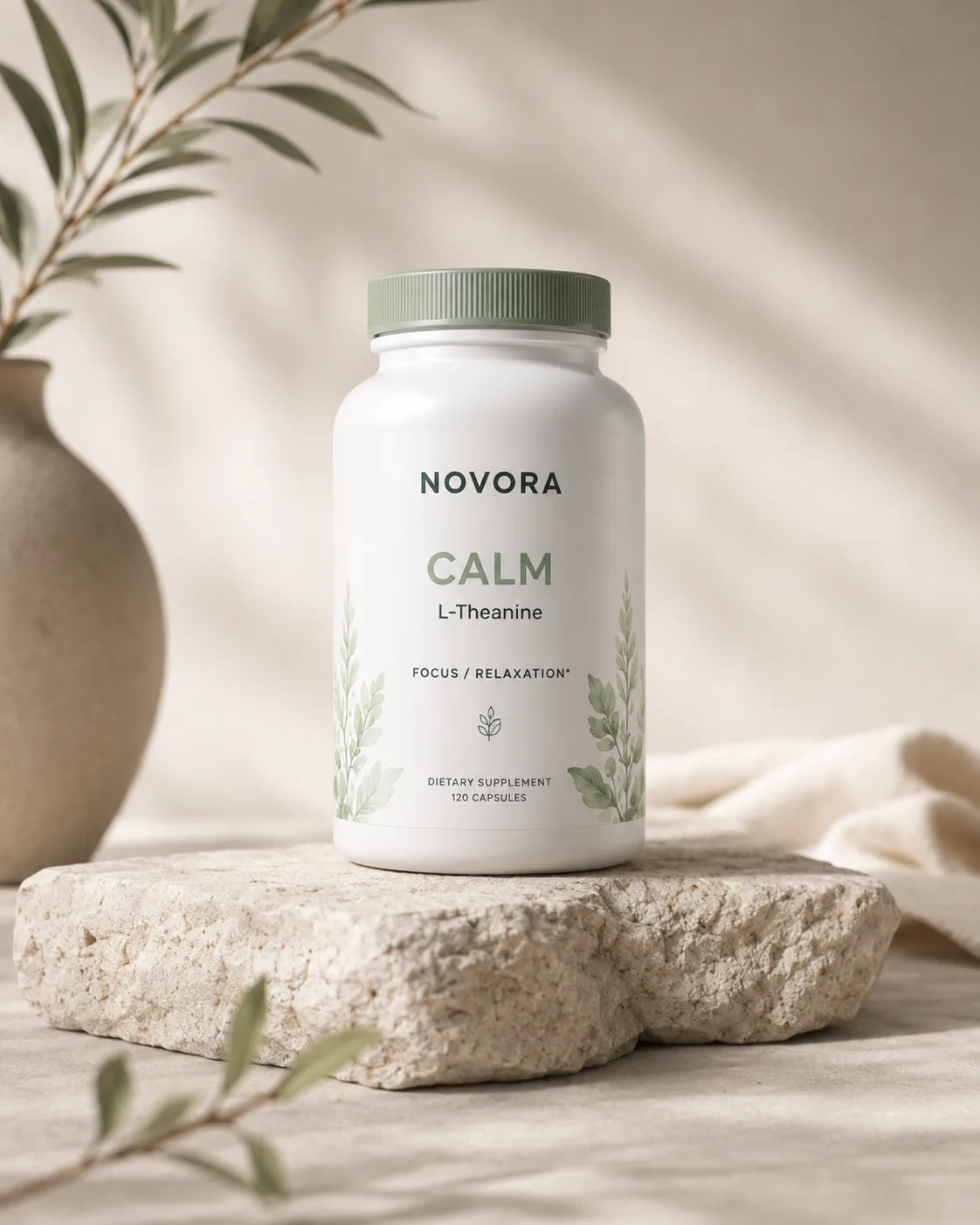
L-theanine: the calm-without-crash amino acid
It’s the reason green tea feels different from coffee. Here’s what it actually does.

Where it comes from
L-theanine is an amino acid found naturally in tea leaves, particularly green tea. It crosses the blood-brain barrier and is associated with increased alpha brain wave activity — a state linked to relaxed alertness, similar to what you feel in early meditation.
How it’s different from a sedative
Sedatives generally work by slowing the central nervous system down, which is why they come with drowsiness. L-theanine doesn’t suppress activity — it shifts the quality of it, which is why the common report is “calmer, not sleepier.” It won’t make you drowsy at your desk.
The caffeine pairing
Several studies on the L-theanine-plus-caffeine combination (roughly the ratio found in a cup of green tea) show improved focus and reduced jitteriness compared to caffeine alone — part of why it’s a popular pairing for people sensitive to coffee’s edge.
What the research supports
Evidence is strongest for reduced subjective stress and anxiety under mild, everyday conditions — a presentation, a deadline, a stressful commute. It’s not positioned or studied as a treatment for clinical anxiety disorders.
L-theanine vs other calming ingredients
Compared to sedative herbs like Valerian, L-theanine's defining feature is that it doesn't come with drowsiness — it's built for daytime use, not evening wind-down. Compared to prescription anti-anxiety medication, it's far milder and works through a different, non-habit-forming mechanism. It occupies a specific niche: calm that doesn't cost you alertness.
Does it help sleep too?
Indirectly, for some people — by easing daytime tension, it can make it easier to switch off at night. But L-theanine isn't formulated or dosed as a sleep aid on its own the way Valerian or Melatonin are; if sleep is the primary goal, a dedicated evening formula is the more direct fit.
Who tends to notice it most
People who describe themselves as sensitive to caffeine, or who feel wired-but-tired under everyday pressure, tend to report the clearest effect. It's less noticeable for people who are already generally calm — there's less "edge" for it to take off.
Building it into a stressful day
Because it's non-habit-forming and doesn't blunt alertness, L-theanine works well taken situationally — before a meeting that reliably makes you tense, alongside your morning coffee to soften the jitters, or any point in the day where focus starts slipping into scatter.
When to take it
Because it’s non-habit-forming and doesn’t cause drowsiness, it can be taken as needed rather than on a fixed schedule — before something that reliably makes you tense, or any time the day feels like it’s running you instead of the other way around.
Typical dosing in the research
Most studies showing a calm-focus effect use doses in the range of 100–200mg, often alongside a modest amount of caffeine. Higher isn't necessarily better here — the effect is subtle by design, and the research doesn't support the idea that doubling or tripling a dose meaningfully doubles the effect.
Daytime calm vs. nighttime sleep support — not the same tool
L-theanine is built for staying clear-headed and calm while you're still working or engaging with the day; it isn't formulated or dosed as a sleep aid. If the goal is actually falling asleep at night, an evening blend built around ingredients like Valerian, Chamomile and Melatonin is a more direct fit — using a daytime-calm ingredient at bedtime, or vice versa, is a common and avoidable mismatch.
L-theanine and physical stress or exercise
Some people use L-theanine before physically demanding or high-pressure situations — a competition, a stressful shift — specifically because it doesn't blunt alertness or physical readiness the way a sedative would. It's not a performance enhancer in the athletic sense; the appeal is staying composed without feeling dulled.
Common misconceptions about L-theanine
It's sometimes assumed to be a sedative because it's "calming," which leads people to expect drowsiness that doesn't come — that's a mismatch of expectation, not a sign it isn't working. It's also sometimes conflated with prescription anti-anxiety medication because of the shared word "calm"; the mechanism, strength and regulatory status are entirely different.
Who might not notice much of an effect
People who are already generally low-stress and rarely feel wired or jittery tend to report a less noticeable effect, simply because there's less tension for it to ease. It's also more subtle than a stimulant or sedative by nature — someone expecting a dramatic, immediate shift may come away underwhelmed even when it's doing what it's formulated to do.
Screen-heavy, high-stimulation days
Long stretches of back-to-back video calls, notifications and screen time can produce a specific kind of scattered, wired-but-tired tension that's different from physical stress. Some people find L-theanine particularly noticeable on these kinds of days precisely because the tension it's addressing — mental overstimulation without physical exertion — is exactly the pattern the research is built around, rather than something more physically demanding.
Frequently asked questions
Is L-theanine habit-forming?+
No. It doesn't work through the same dependency-forming pathways as sedatives or anti-anxiety medication, and there's no established withdrawal effect from stopping.
Can I take it every day?+
Yes — it's commonly used daily, either on a fixed schedule or situationally before stressful moments. There's no evidence it loses effectiveness with regular use.
Does it interact with anxiety medication?+
If you're taking prescribed anxiety or mood medication, check with your doctor before adding L-theanine — combining any calming compounds with prescription medication is worth a professional check first.
Will it make me tired?+
Not typically. L-theanine is associated with relaxed alertness rather than drowsiness, which is the main reason it's used during the day rather than at bedtime.
Can I take it with coffee?+
Yes — this is one of the most common and best-studied pairings, and many people find it specifically smooths out the jittery edge of caffeine rather than causing any issue.
How fast does it work?+
Effects are generally reported within 30 to 60 minutes of taking it, which is part of why it's often used situationally rather than only as a daily baseline habit.
Does L-theanine show up on a drug test?+
No. It's a naturally occurring amino acid found in tea, not a controlled or screened substance, and standard drug panels aren't testing for it.
Can I take it on an empty stomach?+
Yes — there's no fat-solubility or food-dependent absorption issue with L-theanine, so it can be taken with or without a meal depending on what fits your routine.
Is it appropriate for students studying for exams?+
It's commonly used in study or exam-prep contexts specifically because it supports calm focus without drowsiness, but anyone under 18 or with an existing medical condition should check with a doctor before starting any new supplement.
This article is for general information and isn’t medical advice. Talk to a healthcare professional before starting any new supplement, especially if pregnant, nursing, under 18, or managing a medical condition.